
By Matthew Bowes, Senior Associate in Grattan’s Economic Prosperity and Democracy Program.

Matthew Bowes is a Senior Associate in Grattan’s Economic Prosperity and Democracy Program. He has previously worked at the Parliamentary Budget Office and Commonwealth Treasury in various roles analysing personal income tax, budgets, and social policy.
Since 2023, the Minns Government has introduced the most ambitious reforms to improve housing affordability that NSW has seen in a generation.
But the NSW reforms fall short of those adopted by the Allan Victorian Government in one crucial way. Victoria is now allowing more ‘gentle’ density – townhouses and flats up to three storeys – across most residential-zoned land in the capital city. NSW is not.
That’s a huge missed opportunity to get more housing built in Sydney.
This presentation shows why Premier Minns should follow Premier Allan’s lead and allow terraces and low-rise flats in all areas currently zoned for low-density, as long as they meet reasonable set-back, height, and site coverage requirements.
Since 2023 the Minns Government has introduced the most ambitious reforms to improve housing affordability that NSW has seen in a generation.
The government is allowing for mid- and high-rise apartments within walking distance of transit hubs and commercial centres, via the Low- and Mid-Rise Housing and the Transport Oriented Development policies. A range of other policies – such as the Housing Delivery Authority and the In-fill Affordable Housing Bonus – are also making high-rise apartments easier to build in more places.
But the NSW government’s reforms fall short of those adopted by Jacinta Allan’s Victorian Government in one crucial way.
Like NSW, the Victorian Government is allowing taller mid- and high-rise apartments around 60 transit hubs.
But unlike NSW, Victoria is now allowing more ‘gentle’ density – townhouses and flats up to three storeys – across most residential-zoned land in Melbourne.
Victoria’s new Townhouse and Low-Rise Code allows these homes ‘as of right’ across most residential zones, meaning that councils can’t knock back proposed developments that meet clear standards for building heights, setbacks, and site coverage. Heritage protections still apply.
We estimate that Victoria’s Townhouse Code reforms have unlocked capacity for nearly 1 million extra homes in Melbourne’s suburbs, with about 400,000 of these homes being profitable to build today.
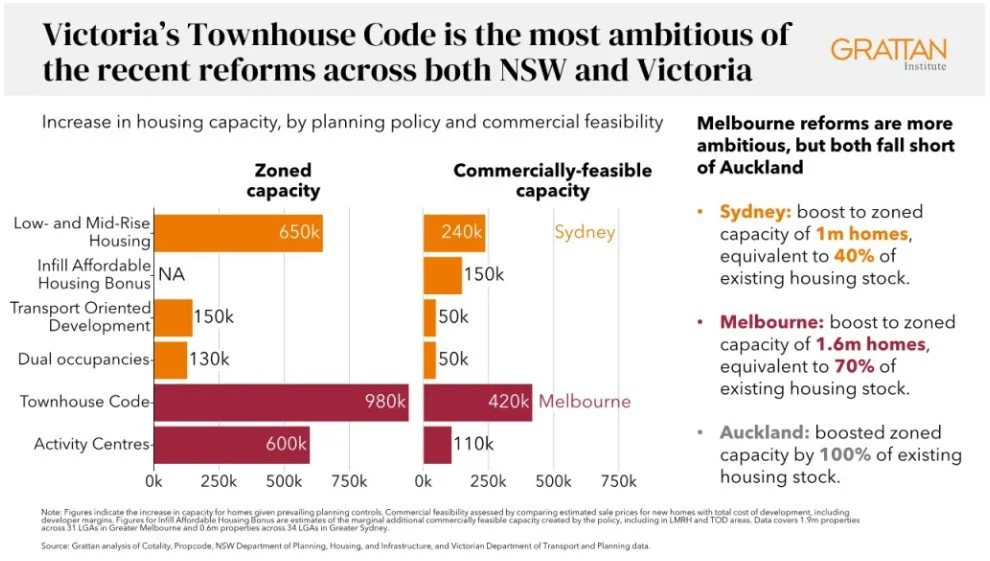
While recent NSW Government reforms have made dual-occupancies legal to build in low-density zoned areas across the state, much gentle density remains illegal to build.
Whereas an 800 square metre site in suburban Melbourne can now accommodate five or more townhouses, similar sites in Sydney are often limited to just two homes
And these reforms are still frustrated by other planning rules, such as minimum lot sizes. In Ku-ring-gai Council, for instance, subdivisions for dual occupancies in low-density areas are only allowed on blocks exceeding 1,000 square metres. It’s why we estimate that dual occupancy reforms in NSW unlock just 50,000 homes that are commercially feasible to build today.
The Low- and Mid-Rise Housing (LMRH) Policy allows more gentle density through to four- to six-storey apartments around 131 sites in Sydney, covering 9 per cent of residential land, but restrictive floor space ratio requirements still apply, especially in the R1 and R2 zones which make up about 77 per cent of LMRH area.
That’s a huge missed opportunity to get more housing built in Sydney
Subdividing large family homes for townhouses is an easy way to allow more housing on scarce inner-city land, offering new housing options for families and downsizers alike.
Half of all residential-zoned blocks in Sydney are larger than 600 square metres, meaning more homes can be built without the need to amalgamate sites. And by avoiding the complexities of high-rise construction, these low-rise projects are cheaper and quicker to build than taller apartment towers.
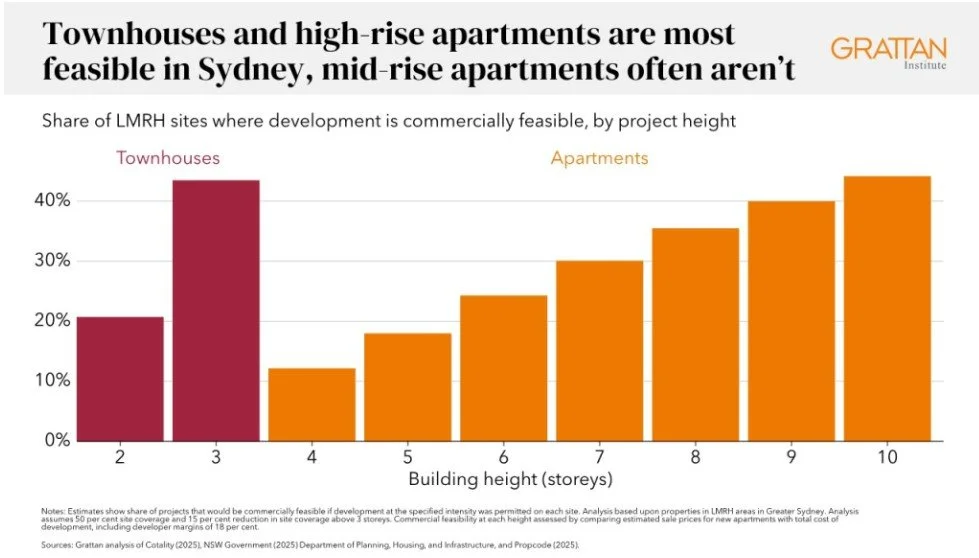
For example, if all housing types were permitted in all Low- and Mid-Rise Housing areas in Sydney, we estimate that three-storey townhouses would be feasible to build on 40 per cent of sites, compared to less than 20 per cent of sites for a five-storey apartment building.
Premier Minns should follow Premier Allan’s lead and allow terraces and low-rise flats in all areas currently zoned for low-density, as long as they meet reasonable set-back, height, and site coverage requirements.
Such a reform could create capacity for more than 1 million extra homes that could be profitably built in Sydney today.
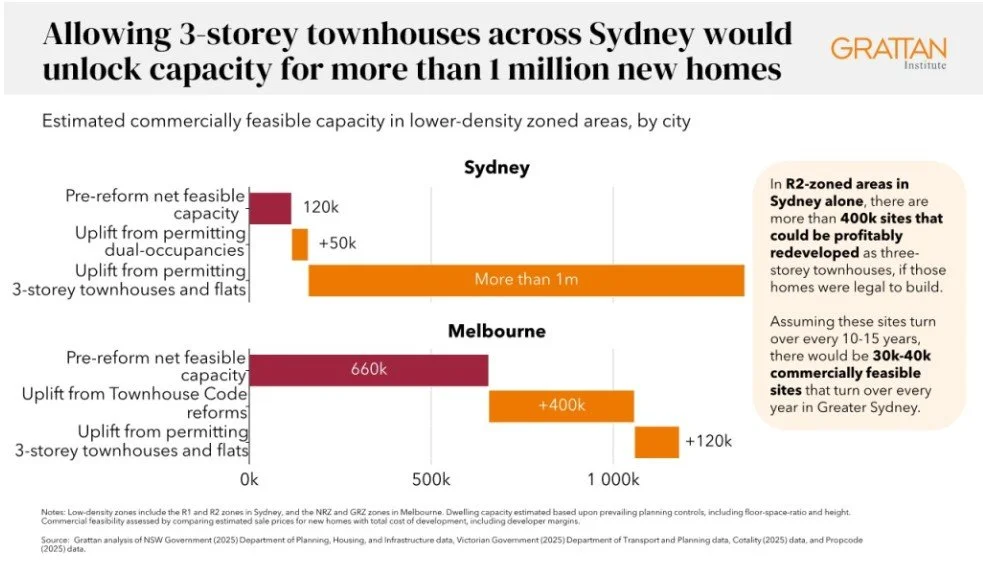
In R2-zoned areas alone, there are more than 400,000 sites in Greater Sydney that could be profitably redeveloped for townhouses, including 37,000 on the Northern Beaches, 37,000 in Canterbury Bankstown, 19,000 in Parramatta, and 18,000 in Ku-ring-gai.
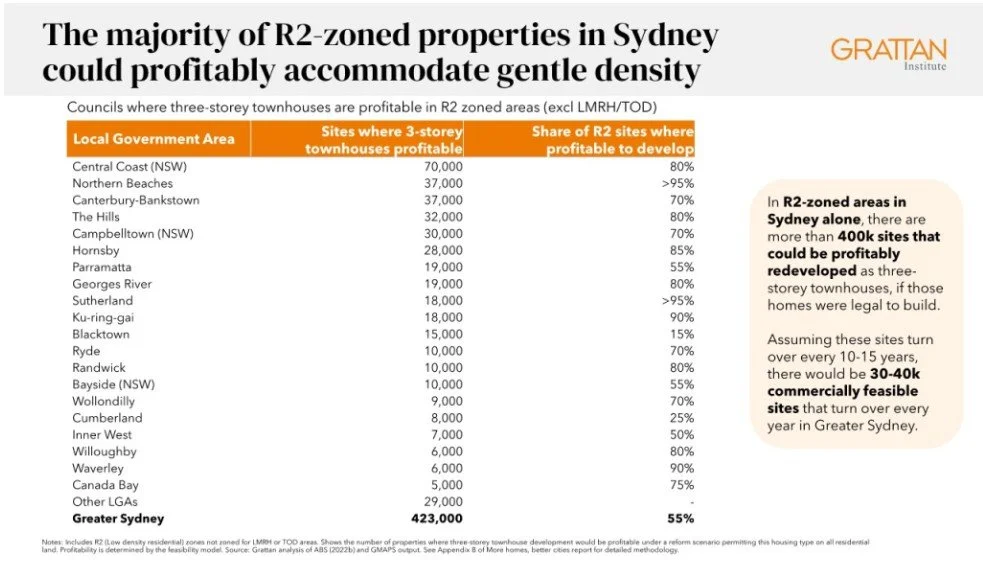
In fact, more than half all R2-zoned properties in Sydney could profitably accommodate three-storey townhouses, if NSW followed Victoria’s example.
Given residential properties in Sydney typically turn over every 10 years, that implies that 40,000 sites that could be profitably redeveloped could hit the market each year in Greater Sydney.
Allowing more homes in Sydney’s inner and middle-ring suburbs will make them cheaper. Newly built townhouses and apartments are much cheaper, on average, than the existing freestanding homes they replace.
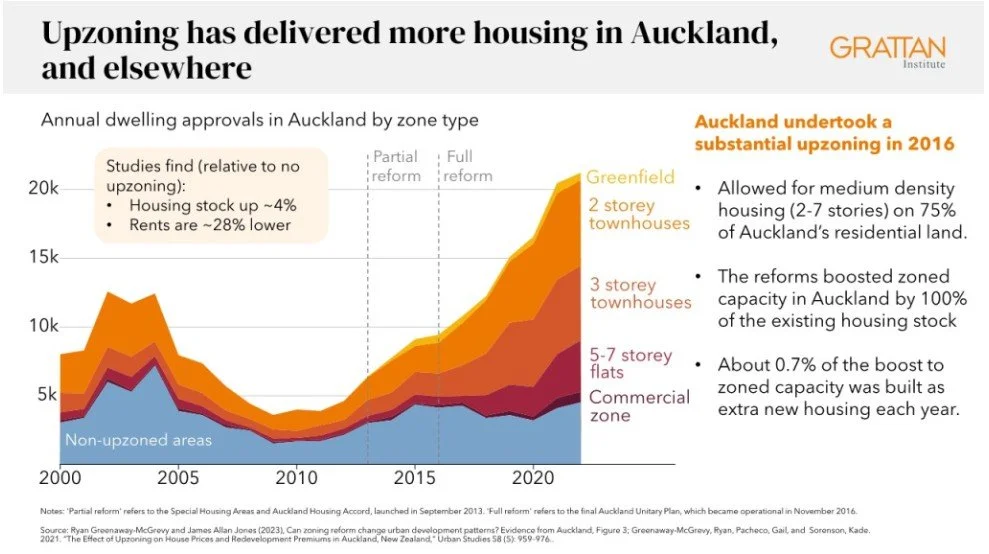
Similar reforms in Auckland, which upzoned 75 per cent of its land area in 2016, led to a building boom that added 4 per cent to the city’s housing stock in just six years and reduced rents by 28 per cent.
Most of the extra housing built in Auckland following its 2016 reforms were two- and three-storey townhouses, rather than taller apartment towers.
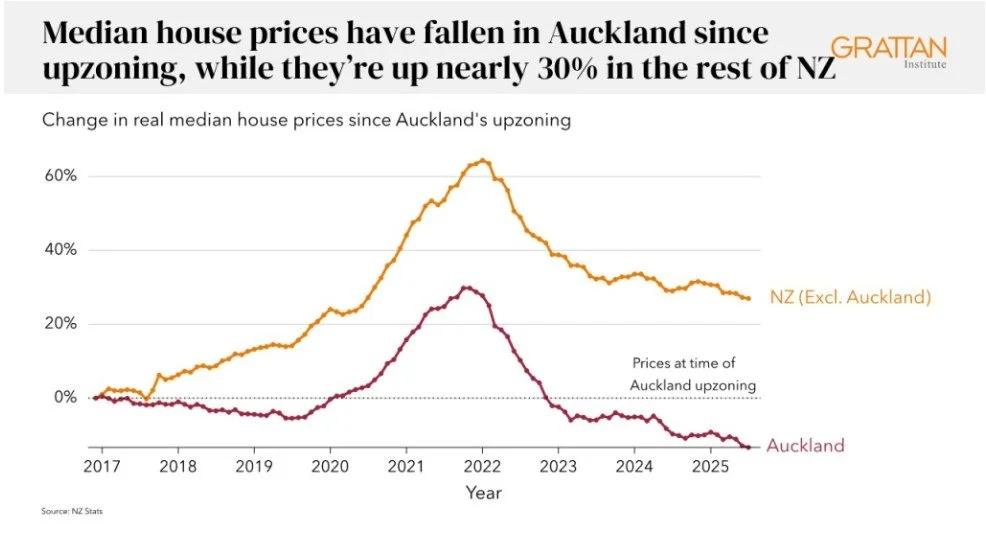
And the benefits of these reforms have now been sustained for a decade, House prices in Auckland have diverged sharply from the rest of New Zealand: house prices in Auckland have fallen by 15 per cent in real terms in the past decade but have increased by nearly 30 per cent increase in real terms for the rest of New Zealand.
Download the presentation pack
Read our ‘More Homes, Better Cities’ report.
This article has been republish under a Creative Commons license. Read the original here.