
By Oliver Nichols, Director Rider Levett Bucknall
Construction activity remains near record levels across Australia, with 838 cranes operating nationwide. While overall numbers have eased slightly, the data points to a market that is evolving, not declining.
Australia’s construction sector continues to demonstrate resilience, with 838 cranes operating nationwide in Q1 2026, according to the latest RLB Crane Index®.
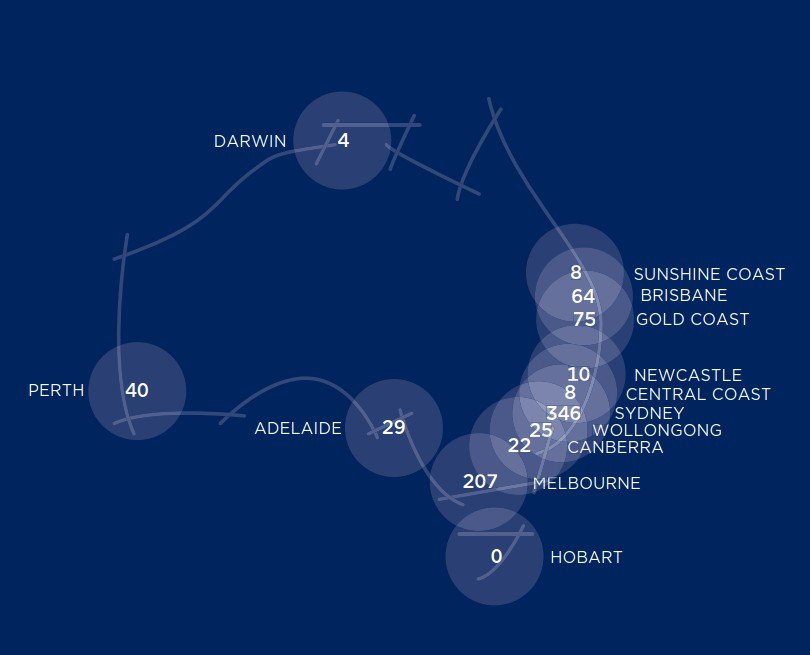
While crane numbers have dipped slightly from 845 in the previous quarter, activity remains high and reflects a sector that is adjusting to new drivers of demand.
The volume of work done reached a record $318 billion in 2025, reinforcing the strength of the underlying market.
A market in transition, not decline
What is emerging is not a slowdown, but a shift.
Across Australia, construction activity is moving between sectors, locations and project types. Residential activity remains a key driver, while engineering, infrastructure and data centres are becoming increasingly prominent.
Melbourne provides a clear example of this transition. Residential cranes now account for 41% of activity, down from more than 50% in recent years, as major civil and infrastructure projects accelerate.
At the same time, data centre construction is expanding rapidly, particularly in Melbourne’s west.
Sydney remains the national centre
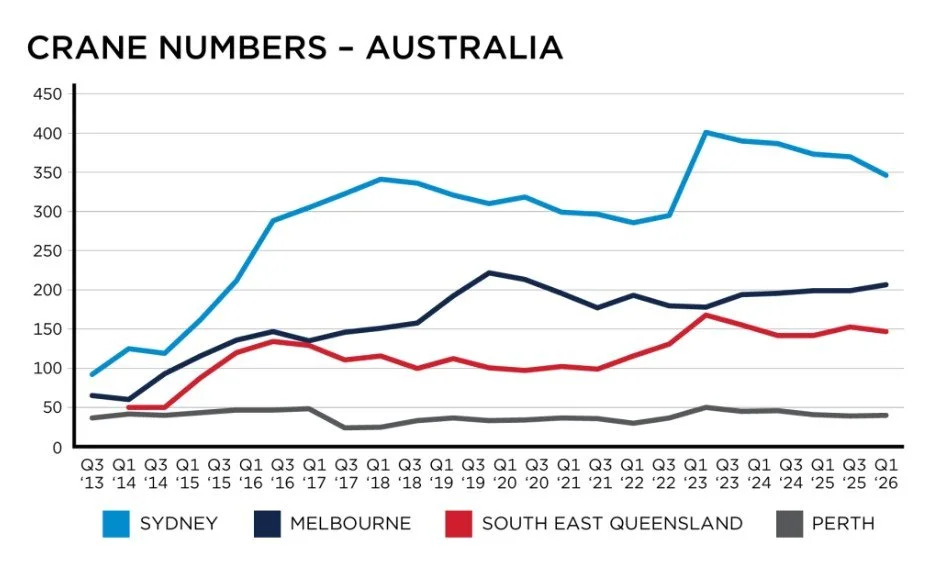
Sydney continues to anchor construction activity in Australia, with 346 cranes in operation, representing 43.8% of the national total.
While this is a modest decline from the previous quarter, activity remains significantly higher than any other city.
Melbourne follows with 207 cranes, with the gap between the two cities remaining substantial.
Growth in emerging regions
Beyond the major capitals, several regions are gaining momentum.
Adelaide has reached a record 29 cranes, supported by strong residential, commercial and health sector activity.
The Gold Coast has also recorded a new high of 75 cranes, driven predominantly by residential development.
These increases highlight a broader redistribution of activity across the country.
Engineering and infrastructure gaining ground
Engineering activity continues to strengthen, supported by investment in energy, water and major infrastructure.
Large-scale projects such as the North East Link and Suburban Rail Loop are reshaping the construction landscape, particularly in Victoria.
Together, these projects account for a significant share of national crane activity and reflect a shift toward infrastructure-led growth.
Pipeline signals remain positive
Forward indicators suggest continued momentum.
Building approvals increased by 15.9% in 2025, pointing to a strong near-term pipeline of work.
While some sectors are moderating, the overall outlook remains one of steady activity, supported by population growth, infrastructure investment and evolving demand. However, new cost pressures are beginning to emerge.
Emerging cost pressures
Geopolitical tensions in the Middle East are now feeding into construction costs, with higher fuel, freight and insurance costs flowing through supply chains.
These pressures are particularly evident in oil-linked materials such as steel, cabling and bitumen, contributing to longer lead times and increased pricing uncertainty.
Diesel-powered crane operations are also exposed, with rising fuel costs placing additional pressure on project preliminaries and overall delivery costs.
Outlook
Australia’s construction market is not standing still.
It is adapting. Rebalancing. Moving toward new opportunities.
The cranes are still there. What’s changing is where they are, and what they represent.
This article has been republished with permission from RLB. Read the original here.