
By Oliver Nichols, Director of RLB in New South Wales and Trent Wiltshire, Chief Economist - Oceania, RLB
Input costs have risen again across Australia’s construction sector. Diesel, freight, concrete and other petroleum-linked materials have all climbed following the re-escalation of conflict in the Middle East. However, in most cities, tender prices have not risen in response.
According to Rider Levett Bucknall’s Construction Market Update for the September quarter, competitive tender conditions are preventing the full impact of higher input costs from reaching clients. In most Australian markets, contractors are absorbing part of the increase as they compete for available work.
“While the re-escalation of the Middle East conflict has pushed up the cost of key construction inputs, including diesel, freight, concrete and other petroleum-linked materials, competitive tender conditions are preventing the full impact from flowing through to tender prices in most markets,” said Oliver Nichols, Head of Oceania Research and Development.
These costs are being absorbed by contractors in most Australian cities, but Perth is bucking the trend with tender prices now forecast to rise more rapidly.
Input costs are up, but pass-through is limited
The cost pressure is real and measurable. Wholesale diesel prices are approaching $2.50 a litre. Concrete suppliers have reinstated surcharges of approximately $7 to $9 per cubic metre, having removed them only in June.
Average cost increases on new projects have risen again in response, but they remain below the levels recorded at the height of the initial conflict-related price shock earlier this year. For now, contractors rather than clients are carrying the difference between input costs and tender prices.
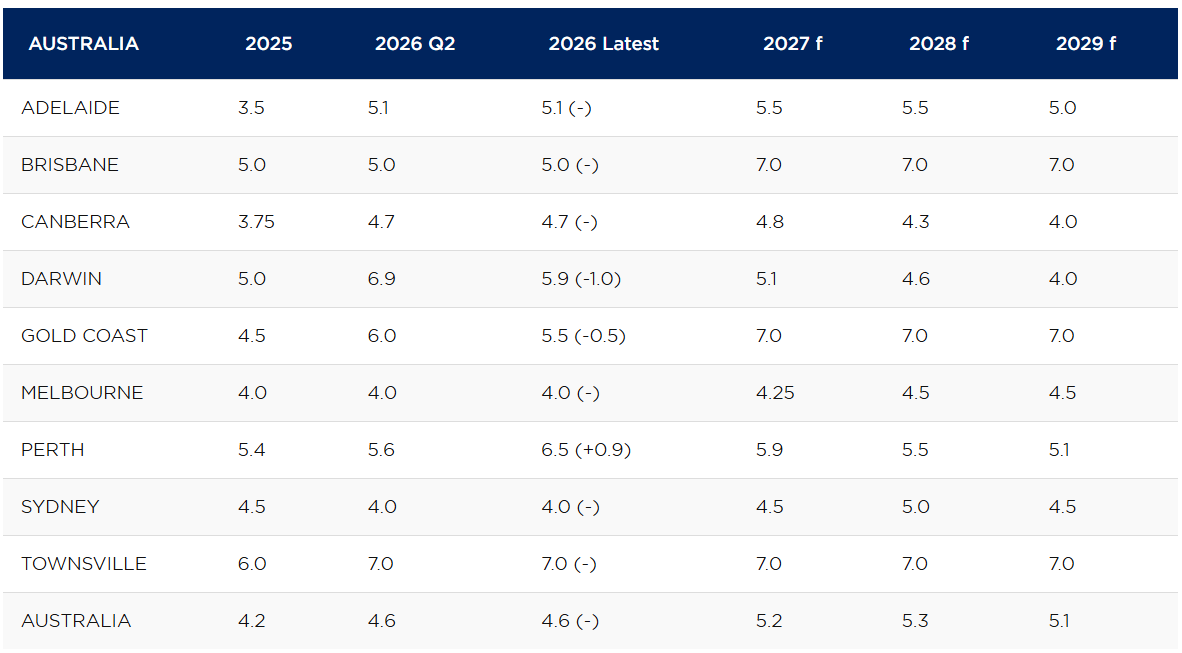
RLB’s national Tender Price Index forecast remains at 4.6% for 2026, unchanged from the June quarter. That national figure conceals considerable variation. Perth is seeing a clear rise in pricing pressure, while softer conditions in Melbourne and Sydney limit contractors’ ability to pass higher input costs through tender pricing.
“The key message from this quarter is that higher input costs are not translating directly into higher tender prices across most Australian markets,” said Oliver.
“Competitive conditions are creating a buffer for developers and asset owners, with contractors absorbing some of the additional cost pressure as they compete for available work. However, that environment is not uniform across Australia and is unlikely to persist indefinitely as major project pipelines put increasing pressure on labour and specialist subcontractor capacity.”
Perth reaches peak capacity and breaks from the pack
Perth is the standout market this quarter.
RLB has upgraded its 2026 TPI forecast for the city from 5.6% to 6.5%, the single largest revision of the quarter.
Western Australia’s construction sector is operating at or close to peak capacity, supported by a strong pipeline across defence, healthcare, renewable energy, manufacturing and residential development. The combination of high workload, skilled labour shortages and wage pressure is producing greater pricing volatility and reducing tender predictability. RLB is also observing considerable variation between projects, including within trade packages, head contractor preliminaries and margin allowances.
The revision means Perth now carries the highest 2026 forecast of the major Australian markets, alongside the elevated 7.0% forecast for Townsville.
Two markets have moved in the opposite direction. Darwin has been revised down from 6.9% to 5.9%, and the Gold Coast from 6.0% to 5.5%, in both cases reflecting softer-than-expected conditions and limited pass-through of higher input costs.
A window for projects that are ready to proceed
The current environment presents an opportunity for projects that can move, particularly where design documentation, approvals and funding are already in place.
In Sydney, tender conditions remain competitive. Subcontractors are actively pursuing forward work and contractors are pricing competitively to secure workload, which is moderating the effect of higher fuel, freight and oil-linked material costs on tender prices.
Brisbane is experiencing a period of increased contractor appetite, particularly for projects below approximately $80 million, as contractors position themselves ahead of the Olympic pipeline. RLB identifies a window of roughly six months for projects that are ready to tender and commence immediately, before rising demand places further pressure on resources.
A competitive tender environment should not be read as falling construction costs. The underlying inputs are more expensive than they were a quarter ago. What has changed is who is currently carrying that cost.
Labour is the larger medium-term risk
Geopolitical developments are driving short-term volatility, but RLB identifies labour availability and labour cost as the more persistent escalation risk for Australian construction.
“Construction labour markets are already tight, particularly in Queensland, Western Australia and South Australia, where online job advertisements for construction workers remain well above pre-COVID levels,” Oliver said.
“At the same time, the number of construction workers is not growing quickly enough to meet the expected workload. Trade and apprenticeship commencements have increased only slightly, migration is slowing and relatively few visas are being issued to construction workers.”
Competition for labour is expected to intensify as major projects move through the pipeline, including data centres, residential and non-residential development, defence and health programs, and the Brisbane 2032 Olympics.
Construction industry enterprise agreement wage growth is at its highest level since the late 1990s.
RLB expects labour capacity and wage pressure to remain a significant constraint even if fuel and freight costs ease.
A record pipeline keeps pressure on capacity
The labour challenge is compounded by historically high levels of activity.
Construction work done reached a record $328 billion in 2025-26, up 4.2% on the previous year.
Residential construction increased 8.1%, with apartment and townhouse construction up 13.2%. Non-residential construction rose 9.3%, driven in part by rapid growth in data centres and health projects. Activity is strongest in South Australia, Western Australia and Queensland, although conditions remain uneven across the country.
Strong pipelines combined with constrained labour and subcontractor capacity mean the current competitive tender environment needs to be read against a longer-term backdrop of elevated cost escalation.
What the forecasts tell us
Across the major Australian markets, TPI growth is forecast to average more than 5% over the next few years. That compares with an average of 3.3% between 2014 and 2019, a useful benchmark for what a normal escalation environment looked like before the pandemic.
RLB’s forecasts point to sustained pressure in several markets:
Brisbane: 5.0% in 2026, rising to 7.0% annually from 2027 to 2029
Gold Coast: 5.5% in 2026, rising to 7.0% annually from 2027
Perth: 6.5% in 2026, followed by 5.9% in 2027
Townsville: 7.0% in 2026 and 7.0% annually through 2029
Adelaide: 5.1% in 2026, and 5.5% in both 2027 and 2028
Looking ahead
“Competitive tendering is providing some relief from the immediate impact of higher input costs, but it should not be mistaken for a return to a low-cost construction environment,” Oliver concluded.
“The underlying fundamentals remain challenging. Construction activity is at record levels, major project pipelines are strengthening, and the availability of skilled labour remains constrained. These factors are likely to keep tender price escalation above historical norms for some time.”
For project owners and investors, the practical implication is one of timing and market selection.
The buffer currently provided by competitive tendering is unevenly distributed, clearly absent in Perth, and dependent on a level of contractor hunger that a strengthening pipeline will eventually remove.
National averages are of limited use in this environment. The conditions in an individual market, and the readiness of an individual project to move, matter considerably more.
RLB TENDER PRICE INDEX ANNUAL % UPLIFTS AS AT Q3 2026
Explore the Interactive Report or download the full PDF version.
This article has been republished with permission from Rider Levett Bucknall. Read original.