
By CEDA and in partnership with Urbis
Danika Adams - Head of Research at the Committee for Economic Development of Australia (CEDA)
Jonathon Mahon - Economist at the Committee for Economic Development of Australia (CEDA)
Clinton Ostwald - Urbis Partner
Executive summary
Australia is not building enough homes, and the homes we do build are taking too long to complete. Projections point to a national shortfall of between 200,000 and 300,000 dwellings against the National Housing Accord target of 1.2 million new homes by 2029. Average construction times have risen 40 per cent since the pandemic. A new standalone home now takes 9.2 months to build. A new apartment building takes 2.4 years.
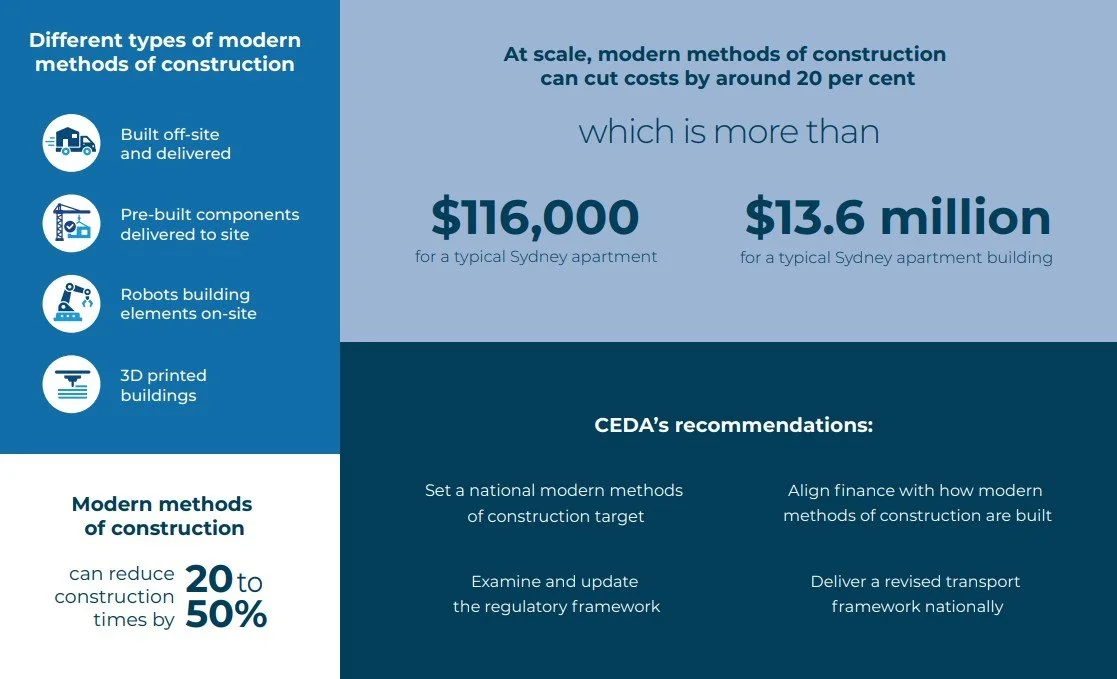
Meeting Australia's housing needs will require building more and building differently. Modern methods of construction (MMC) encompass a range of construction approaches that move building activity, wholly or partially, away from the traditional on-site model. They can reduce construction times by 20 to 50 per cent, cutting two to five months from the average house build. At scale, they can cut construction costs by around 20 per cent. A 20 per cent saving would reduce the construction cost of an average apartment by more than $116,000. For a typical Sydney apartment building, it could lower construction costs by over $13.6 million.
Despite these potential gains, modern methods of construction remain a niche part of Australia's construction sector. The barriers to uptake are mostly regulatory, though they also reflect the lack of industry scale, which in turn hinders uptake further. Australia's regulatory frameworks were designed for traditional on-site construction and create compliance complexity, cost and uncertainty for MMC projects. Financing structures tied to on-site progress milestones do not align with off-site manufacturing processes, limiting access to capital for buyers and producers alike. Fragmented development pipelines constrain the scale needed to make MMC commercially viable. State-based transport regulations add further cost and complexity.
International experience shows that when modern methods of construction are embedded in national housing policy and supported by consistent regulation, stable demand and targeted investment, adoption can accelerate quickly.
Without coordinated policy action, uptake will remain constrained. Realising MMC's potential in Australia requires reform across planning, building standards, financing and transport, alongside investment in workforce capability and pipeline certainty.
RECOMMENDATIONS
Set a national modern methods of construction target
1. The Federal Government should set a target for the delivery of MMC homes. Greater adoption in social and affordable housing should lead this target, building the demand certainty manufacturers need to invest at scale.
Examine and update the regulatory framework
2. The 'Modernising the National Construction Code' review should deliver concrete reforms to remove barriers to MMC. In parallel, the Australian Building Codes Board should publish nationally consistent MMC
definitions as formal guidance ahead of their incorporation into the National Construction Code.
3. State and territory governments should establish dedicated modern methods of construction approval
pathways.
Align finance with how modern methods of construction are built
4. The Federal Government should encourage standardised MMC finance products across the banking
sector.
5. State and Territory governments should consider low-interest finance for MMC manufacturing facilities.
Deliver a revised transport framework nationally
6. Transport Ministers, working through the National Transport Commission, should deliver harmonised permit and escort requirements for prefabricated module transport, through the next phase of Heavy Vehicle National Law reforms.
CONCLUSION
Modern methods of construction offer real opportunities to improve housing outcomes in Australia. The potential benefits are well established through faster construction, lower costs at scale, and a pathway to addressing the productivity decline that has affected the construction sector for decades.
The barriers to realising these benefits are commonly regulatory and financial. Regulatory frameworks built around traditional on-site construction create compliance complexity for projects that are constructed off-site. Financing structures tied to on-site milestones do not align with off-site manufacturing. Fragmented development pipelines make it difficult for manufacturers to invest at the scale needed to make the economics work. Overseas examples show that these barriers can be overcome, and that the benefits of doing so are substantial.
Modern methods of construction are not a silver bullet. But they are a tangible, evidence-based pathway to increase housing supply faster than traditional construction methods can deliver. The productivity time savings are measurable, and at scale, there could be real cost savings.
This article has been republished from CEDA under a Creative Commons license. Read original. Read full report here.